CROSS OVER VALVES
Crossover valves represent a critical intervention point on any Dive Control panel. When improperly aligned or altered during a dive, they introduce line pressure instability, false gauge readings, and the potential for diver depth misattribution. To prevent accidental operation, crossover valves must either be mechanically locked or have their control handles removed during active diving operations. Furthermore, whenever a single instrument is configured to read across alternate sources—particularly when monitoring the depth of more than one diver—the valve assembly must feature permanent, high-contrast source tags and clear open/closed indicators. Best practice dictates independent, dedicated gauges for each diver; however, where selector valves exist, rigorous valve tagging and positive identification are mandatory prerequisites before recording any life-support parameter.
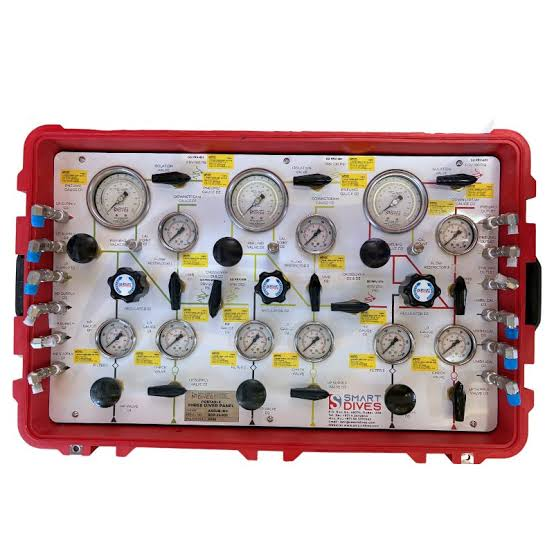
Crossover Valves & Dual-Circuit Instrumentation Protocols
In Dive Control manifolds and gas management panels, crossover valves bridge redundant gas supplies or switch measuring circuits between multiple working divers. Improper configuration or manipulation of crossover valves creates severe life-support hazards, including hydraulic instability, pressure transients, and misattribution of critical depth data.
Operational Risks
Erratic & Fluctuating Gauge Readings: Actuating crossover valves while lines are pressurized introduces transient pressure differentials across the sensing element, producing needle flutter, unstable readouts, and misleading supply pressure indications.
Gas Cross-Contamination: Inadvertently bridging independent gas banks risks cross-mixing incompatible breathing mixtures (e.g., bottom gas into high-oxygen decompression supplies).
Depth Misattribution: Where a single pneumofathometer or depth indicator is plumbed to monitor more than one diver via a selector valve, an incorrectly positioned valve displays the depth of Diver 2 while the supervisor believes they are monitoring Diver 1—a catastrophic failure mode during decompression stops.
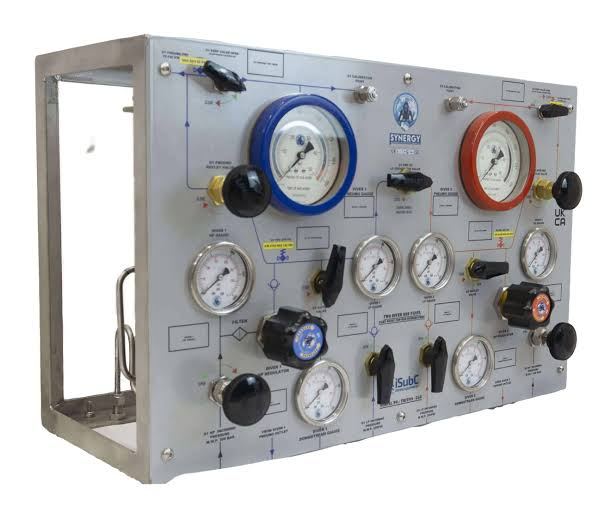
Mandatory Engineering & Operational Controls
Tamper Prevention & Mechanical Security:
Crossover valves intended to remain in a fixed operational state must be mechanically locked, wire-locked, or have their operating handles removed to eliminate accidental actuation.
If handles are detached, they must be retained in a designated emergency station adjacent to the console.
Source & Line Identification:
Crossover manifolds must incorporate distinct, color-coded mimic schematics on the panel face clearly showing the flow path and active source.
Gauges serviced by crossover circuits must feature permanent, engraved tags identifying which primary and secondary sources they monitor.
Valve Status Indication:
Every crossover and selector valve must have unambiguous, high-contrast open/closed and directional flow markers.
Vague markings (such as generic quarter-turn lever positions without labels) are non-compliant with commercial diving equipment safety standards (e.g., IMCA D 018 / D 023).
Multi-Diver Shared Gauges:
While dedicated, independent depth gauges per diver are the mandatory baseline across modern operations, any legacy or secondary crossover setup servicing multiple divers must feature high-visibility selector tags (e.g., "DIVER 1 ONLY" / "DIVER 2 ONLY") and require positive verbal cross-checks between the Dive Tender and Diving Supervisor before any stop depth is recorded.
| Risk Factor | Root Cause | Engineering / Procedural Control | Verification Requirement |
| Supply Pressure Instability | Rapid equalization across different manifold pressures | Controlled slow-opening protocols; dedicated upstream line balancing | Verify needle dampening and stabilization prior to logging readings |
| Accidental Position Shift | Inadvertent contact by console operator | Valve handle removal, mechanical detents, or locking pins | Pre-dive checklist sign-off confirming locked valve configuration |
| Misread Diver Depth | Shared pneumofathometer selector in wrong position | Dual independent gauges preferred; high-visibility engraved source selector tags | Verbal read-back and mechanical valve confirmation before initiating ascent |
| Ambiguous Valve Alignment | Worn, missing, or obscured directional markings | Permanent panel mimic lines, engraved directional tags, open/closed flags | Visual audit during daily pre-dive equipment checks |
There are no comments for now.
to be the first to leave a comment.